

INTRODUCTION
Have you ever wondered why sensor manufacturers like Membrapor produce electrochemical cells in different sizes? What is the purpose? And are they interchangeable? This white paper draws attention to a frequently asked question in the industry.
The different sensor sizes such as Compact (7-series), Miniature (4-series) or Vantage (5-series) have been developed over the years to suit different customer needs. Other sizes have also been promoted. There is a trend towards smaller sensors. While one customer needs small cells to fit their portable devices other customers require a high filter capacity to withstand harsh conditions. The third one needs high output signals to ensure a reliable detection of ppb-level gas concentrations.
The insides of an electrochemical cell are typically arranged in a stacked configuration. The capillary controls how much gas flows into the sensor. This diffusion control makes the sensors work pressure independent. The sensing (or working) electrode on top is where the reaction happens. The sensing electrode is in contact with an electrolyte and electronically connected to the reference electrode. The counter electrode closes the circuit by reducing O2 or oxidizing H2O (when liquid electrolytes are used). This basic setup applies to all sensor sizes. Therefore, properties like temperature behavior, cross sensitivities or drift are very similar if the same sensor type is considered (e.g. CO-sensor for a detection range of 0 – 200 ppm). In the next sections the main differences are described in more detail.
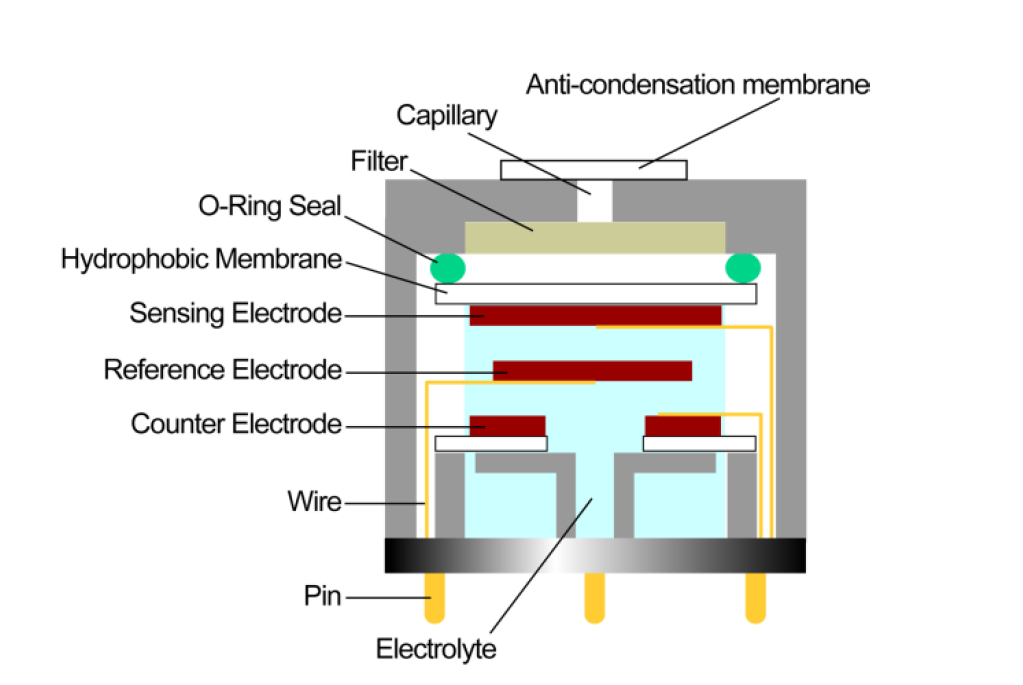
Figure 1: Working principle of an electrochemical gas sensor.
The insides of an electrochemical cell are typically arranged in a stacked configuration. The capillary controls how much gas flows into the sensor. This diffusion control makes the sensors work pressure independent. The sensing (or working) electrode on top is where the reaction happens. The sensing electrode is in contact with an electrolyte and electronically connected to the reference electrode. The counter electrode closes the circuit by reducing O2 or oxidizing H2O (when liquid electrolytes are used). This basic setup applies to all sensor sizes. Therefore, properties like temperature behavior, cross sensitivities or drift are very similar if the same sensor type is considered (e.g. CO-sensor for a detection range of 0 – 200 ppm). In the next sections the main differences are described in more detail.
FILTER CAPACITY
Some electrical cells use an onboard filter which is installed between capillary and sensing electrode. The purpose is to increase the sensors selectivity towards the target gas. CO sensors, for example, have a high cross sensitivity towards acidic gases such as SO2, NO2 or NO. The onboard filter removes these gases. The filter capacity (typically expressed in ppm∙hr) indicates how long the filter lives before the surrogate gases
penetrate and possibly cause false readings (see MEM1 2025). The Vantage (5-Series) line has the largest filter capacity and is around several hundred thousand ppm∙hr, depending on the sensor type and capillary size. The Compact (7-series) for the same measurement range has about half the filter capacity of a Vantage line sensor. The Miniature (4-Series) has not even 10% of the filter capacity of a Vantage line. If you are selecting a sensor for a complex gas matrix (e.g. combustion) the recommendation is to use a Vantage or Compact sensor size. If you select a Miniature size, an external filter cartridge is highly recommended.
ELECTRODE SIZE
The electrode size determines to some extend the sensor’s reactivity. As a rule of thumb one can say that a larger electrode area will increase the sensitivity. This does strongly depend on the electrode’s material, porosity and the interaction between electrode, electrolyte and gas molecules. Certain industries therefore rely strongly on the Compact size sensors
and prefer those over the Miniature size. This is the case for air quality monitoring or even Time-Weighted Average (TWA) threshold monitoring in semiconductor industries. With the uprise of better, low-noise electronic circuits this has become less pronounced and even sensors with smaller electrodes perform admirably for ppb-level measurements. The electrode size can also condition the sensor lifetime, especially for applications where
poisoning agents appear (e.g. biogas). Therefore, we recommend using the Compact size for all applications requiring accurate measurements of low signal levels.
ELECTROLYTE VOLUME
The electrolyte volume is important for applications under extreme humidity conditions and when liquid electrolytes are used. Typically, bigger sensor housings have a larger volume available for electrolyte. This is especially important under high humidity conditions (> 90% R.H.). The water uptake becomes a crucial factor and can result in leakages if the there is not enough volume for the electrolyte to expand. In such applications or geographic areas, we recommend using the Compact size.
CONCLUSION
All sensor sizes are important and have their benefits. Which one do you select? Here is an easy checklist to follow:
- How is my gas matrix? Do I require an onboard filter, or do I work with external filter
cartridges? - What is the application’s humidity?
- How does my electronic footprint look like? How is my general instrument design?
- Do I need interchangeability across suppliers?
- What is the general lifetime I seek in an electrochemical cell?