
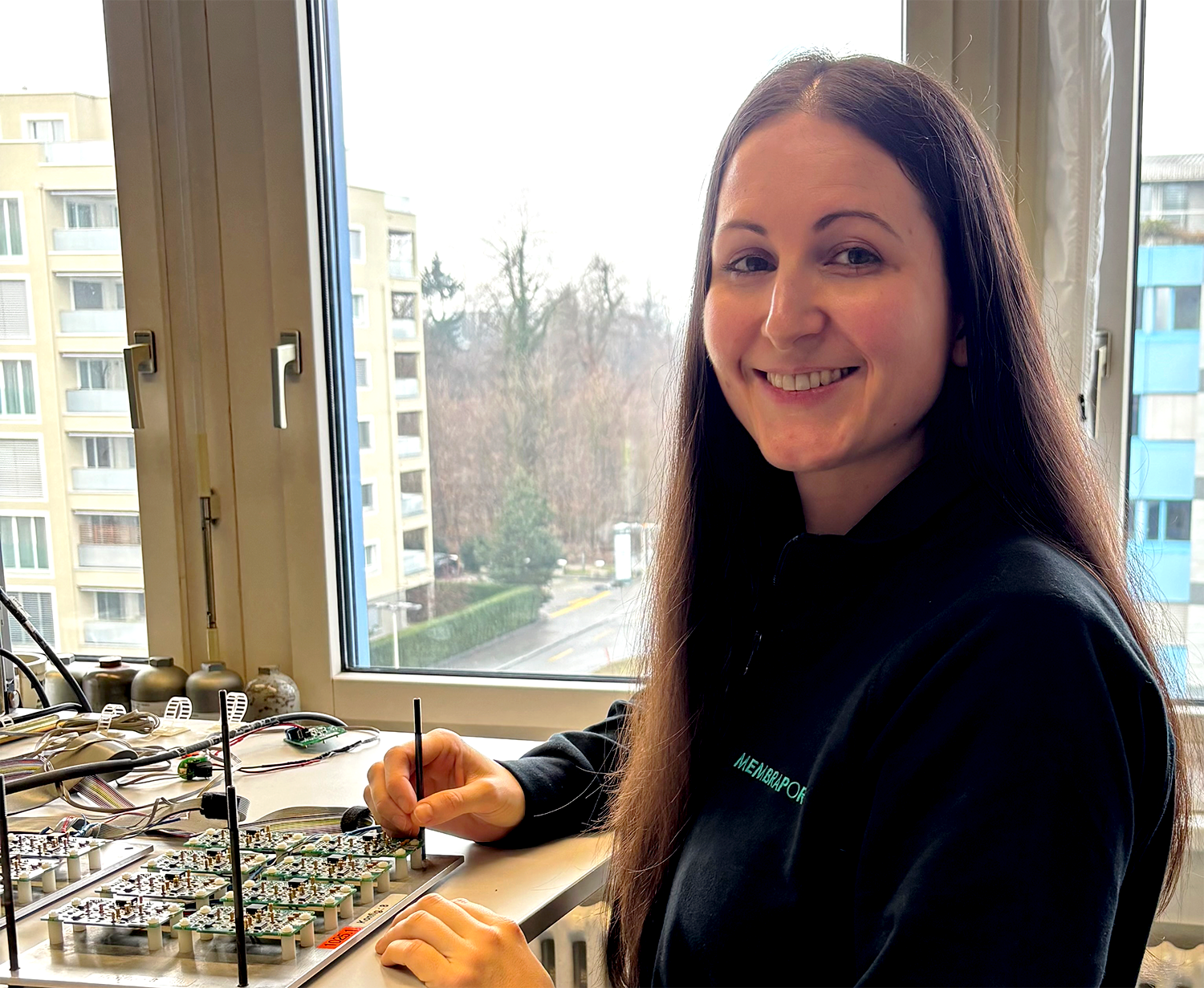
To mark International Day of Women and Girls in Science, we are talking to Patrizia Huggenberger today. As a qualified chemist, she plays an important specialist role in Membrapor’s six-person research and development team and, as the daughter of Membrapor’s founder, is continuing a tradition. In our conversation, we learn how her fascination with technology began and what she would like to pass on to girls, women, and society in general.
Did your path to science already become apparent when you were a child?
Since my father is a chemist, I came into contact with science at an early age. Of course, I experienced the early days of Membrapor firsthand. Back then, my father assembled the first sensors at his desk at home and experimented with gases and filter powder in the basement. As a child, however, I didn’t understand much about it. When people asked me what my father did for a living, I always said “he screws together housings.”
I didn’t start studying science subjects until I was already a teenager, halfway through high school. At least, I don’t remember having science classes in elementary school. Looking back, I can say that enthusiasm for a subject certainly depends heavily on how it is taught by the teachers. I was particularly interested in biology and physics, but chemistry classes were rather dry.
Was there a key moment that made you decide to study chemistry?
It may sound a little unromantic, but one of the main reasons was that I much preferred practical work to endlessly poring over books under time pressure and memorizing facts. Chemistry offers a good mix of experimentation and thinking. I was also aware that a degree in a scientific subject like chemistry offers very good job prospects.
What does a “normal” working day look like for you?
The day always starts with coffee and the daily scrum, where you briefly tell your team what you have planned for the day. My daily work usually involves a mix of experiments, writing reports, meetings, and sometimes spontaneous but very interesting theoretical discussions with my team colleagues.
What do you particularly like about your daily work?
I appreciate the diversity and interdisciplinarity. Even after almost seven years in my job, I am still learning new things, which keeps the profession very exciting. I recently learned that a cylindrical metal housing cannot simply be placed in an electroplating bath and then gold-plated. In terms of design, a number of things have to be taken into account to ensure that the gold plating is complete and uniform.
«Chemistry opens up far more career opportunities than you might think: from the development of anti-aging creams and new pharmaceutical ingredients to the design of innovative materials and chocolate that melts perfectly on the tongue—there’s something for everyone!»
Patrizia Huggenberger, Chemist at Membrapor AG, about chemistry
A claim: When you meet someone new and tell them what you do for a living, they look at you in amazement. Is that true?
That’s right. I often get the following reaction: “Oh, chemistry. I couldn’t do that. I was always bad at it.” Unfortunately, this reaction usually comes from women, which I find very unfortunate, as we women are in no way inferior to men.
Is there anything you would like to say to girls, women, or society?
Chemistry opens up far more career opportunities than you might think at first glance. Chemistry opens up far more career opportunities than you might think: from the development of anti-aging creams and new pharmaceutical ingredients to the design of innovative materials and chocolate that melts perfectly on the tongue—there’s something for everyone. This diversity of career opportunities and current research topics should be given greater emphasis in chemistry lessons in order to make studying chemistry more appealing in general. I would also like to emphasize that the profession of chemist is very compatible with family life, especially when working in research and development in industry. I myself am a mother of two small children and work part-time, but that doesn’t stop me from remaining fully committed to my career.
Great! Thank you very much for the interview and the insight into your work, Patrizia.
Interview: Andrea Zimmermann